what metal can be hardened to the 1025 condition
The word "Atmosphere" gets thrown effectually a lot in the metals manufacture. The most mutual connotation refers to a hardened land of material, or the human activity of hardening through tempering. If we consider the annealed land, the state after which an blend has been heated to above its recrystallization temperature and soaked until the desired grain size is achieved, to exist the baseline for that alloy'due south strength, tempering tin can be defined as interim upon the blend in order to increase its force beyond the annealed land. In the case of Ulbrich Specialty Strip Mill, the activity we impart on our alloys in order to temper or harden them is work hardening through cold rolling.
Cold rolling, a wrought metal process, induces cold work, or plastic deformation without preheating, past reducing the thickness of a strip metallic coil. This plastic, or permanent deformation, induced by the rolling procedure, causes not but a macroscopic alter in production dimensions, merely also a microstructural alter resulting in work hardening. In the eyes of someone observing the rolling procedure, the metallic strip advances through two piece of work rolls, one in a higher place and one below, and via a combination of vertical forcefulness and longitudinal tension, the strip is squished down and fabricated thinner, longer and stronger. The rest of this essay will cover the microscopic phenomena that facilitate these changes.
In order to understand work hardening, some metallurgical basics must first be understood. The metallic alloys manufactured by Ulbrich, consist of an array of microscopic crystals chosen grains, randomly oriented throughout the majority of strip. The building blocks of an individual grain are the atoms of the elements which make up an alloy, such equally carbon, atomic number 26, nickel, chromium…etc. The grains of an blend accept a thermodynamically preferred repeating arrangement of atoms, called a unit prison cell, based on the alloy's chemic composition. A homogenous department of metal consisting of one repeating unit cell forming ane or more grains can be chosen a phase. Certain alloy families are even named after phases. The 300 series stainless steel alloys are referred to as austenitic considering they consist predominately of the austenite phase in the annealed condition. Sure 400 serial alloys like 430 are referred to every bit ferritic due to their ferrite stage, while others similar 410 and 420 are referred to as martensitic due to their martensite phase. The mechanical properties of an alloy are a function of the phases existing inside the alloy too as the size and arrangement of the grains of each phase.
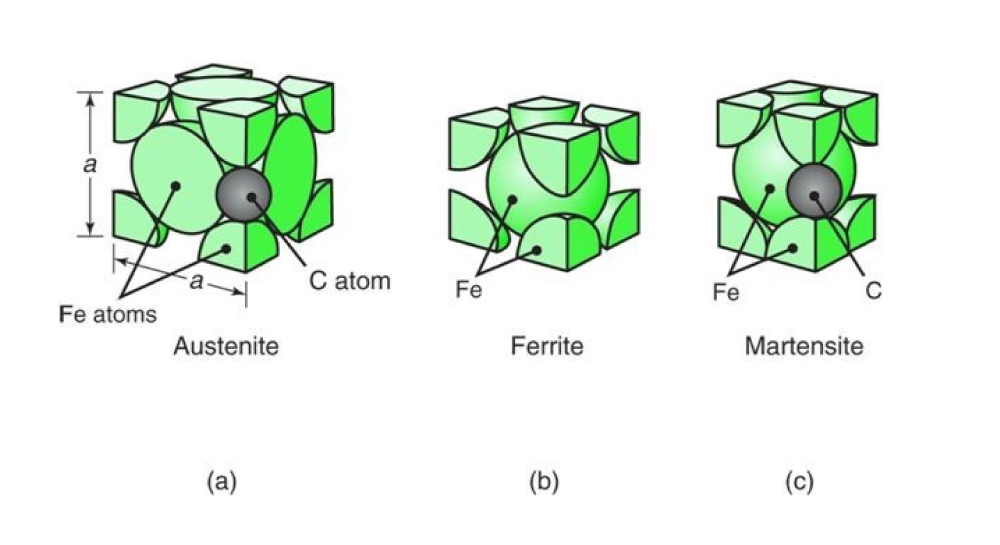
(a) Austenite unit jail cell displaying the arrangement of atomic number 26 (Fe) and carbon (C) atoms; (b) Ferrite unit of measurement cell displaying the organisation of atomic number 26 (Fe) atoms; (c) Martensite unit of measurement jail cell displaying the organisation of fe (Fe) and carbon (C) atoms
So where does work hardening gene into all this? In all but very specialized cases, wrought metal products do not consist of a single grain with a perfect crystal structure that repeats throughout. Similar all things in life, metals are imperfect. Everyone knows the phases of water. Gaseous water vapor, liquid h2o and solid ice. Like h2o, when heated to a loftier plenty temperature, metals will cook and even evaporate at extremely loftier temperatures. Known ratios of the constituent elements of an blend are melted in a huge crucible, mixed into a homogenous solution and so cast into ingots of that blend. When a liquid metal solidifies, unless extreme intendance is taken to facilitate the precipitation and growth of a single grain, solid grains of the thermodynamically preferred phase will precipitate anywhere the pressure level, temperature and chemical composition allow them to. Many grains will precipitate wherever they tin and grow until they encounter another grain, at which point a grain purlieus is formed.
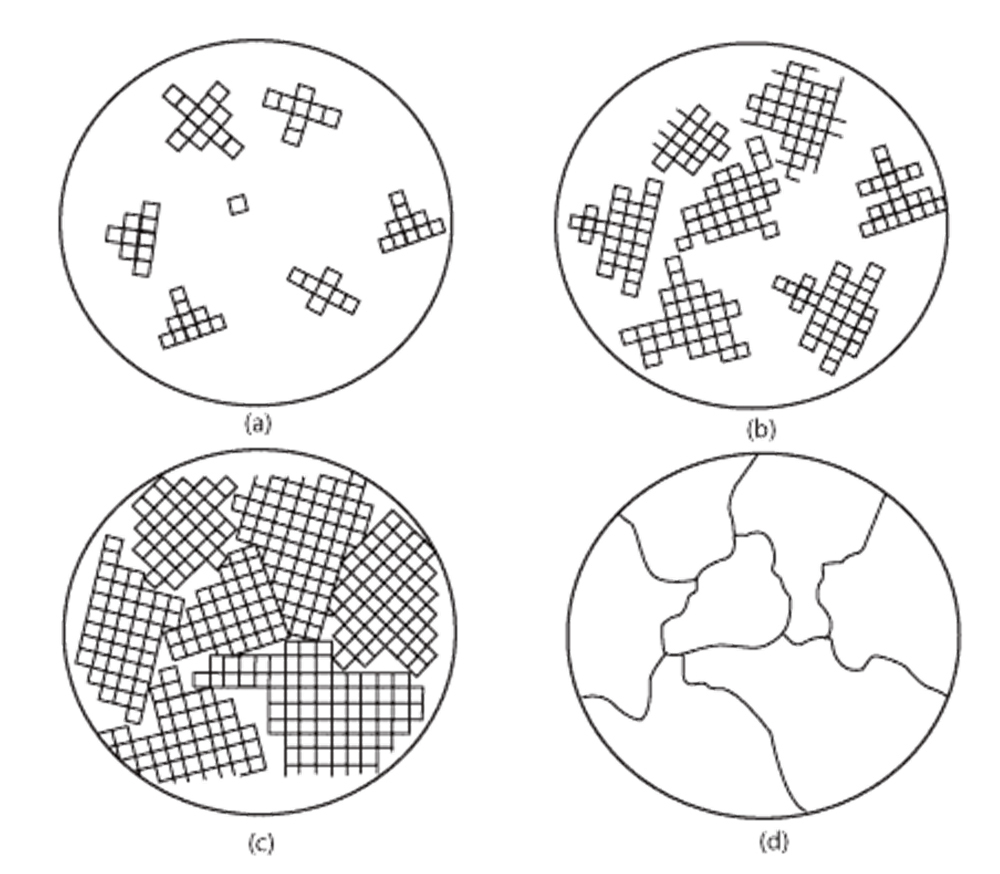
(a) Initial grain precipitation; (b) Grain growth; (c) Farther growth and purlieus germination; (d) completed grain structure
Eventually the entire bulk will consist of these randomly oriented grains. This aforementioned process occurs when an alloy is annealed, but instead of turning into liquid, the grains dissolve into a solid solution and and so recrystallize and grow as a function of time at temperature and cooling rate, substantially resetting the microstructure. Anytime a grain is formed, there is a gamble for one or more line defects, or missing pieces of a crystal structure know equally a dislocation to be. These imperfections, the dislocations in a crystal structure and their subsequent movement throughout a grain and beyond grain boundaries are the basis of metallic ductility. When all the atoms are where they are supposed to be in a crystal structure, there is no room for movement beyond the diminutive bonds stretching, and vibrations throughout the structure. When yous remove an atom, you create an opportunity for another cantlet to slide into that spot, finer moving the dislocation. When a force acts on the bulk alloy, the amass motility of the dislocations in a microstructure allows for plastic deformation without fracture.
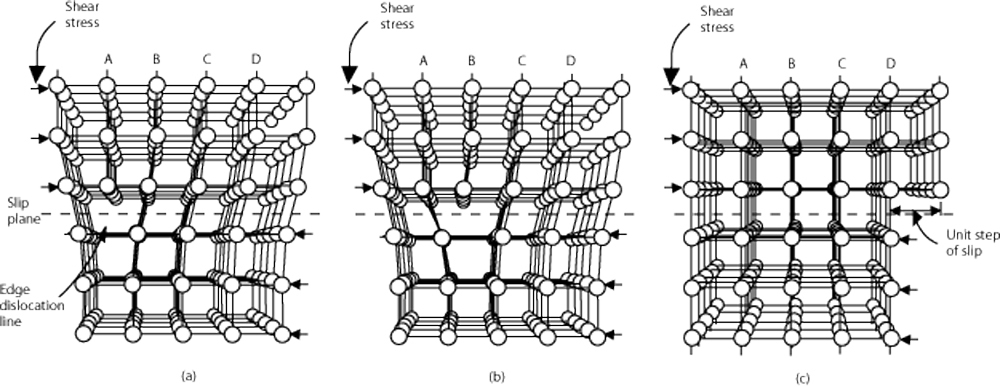
(a) Lattice with dislocation; (b) Dislocation movement inside lattice; (c) Plastically deformed lattice
This is where work hardening comes in. When a force is acted upon the bulk blend, work is done to information technology, meaning energy is added to the organisation. If plenty energy is added to result in plastic deformation, the crystal lattices are strained and new dislocations form. This seems like it should increase ductility, because there are more gratuitous spaces and therefore more potential for dislocation movement. Still, when a dislocation runs into another dislocation, they can lock, or pin each other in place. Every bit the number and concentrations of dislocations increase, more than and more dislocations get pinned together, reducing ductility. Eventually, there will exist so many dislocations, that no more dislocations will be able to form as a result of cold work. The existing pinned dislocations cannot move, and so the atomic bonds in the lattice stretch and stretch until they break, causing a fracture. This is why alloys work harden and why in that location is a limit the amount of plastic deformation a majority alloy can take before it breaks. Common cold working an alloy can even change the phase of the microstructure. As free energy is added to an austenitic alloy and the microstructure is strained more and more, some of the austenite volition actually transform into martensite. At room temperature, martensite has higher strength and less ductility than austenite, which results in a stronger, only more than breakable status. It is also why 300 series alloys are non-magnetic in the annealed land and increment magnetism with work hardening; Austenite is not-magnetic while martensite is magnetic.
The charge per unit at which an alloy strengthens in response to cold piece of work is called the work hardening charge per unit. It is not necessary to discover all of the microstructural changes going on during cold piece of work to predict fabric performance. When it comes to 300 series stainless steels, or austenitic stainless steel, adjusting the chemic limerick can change the work hardening charge per unit. Different elements help stabilize certain phases and tuning the amount of these elements can assistance command the work hardening rate. For example, increasing the Nickel content in austenitic stainless steel will irksome downwards the piece of work hardening rate. This is why 301 stainless steel (half-dozen-8% Nickel) work hardens faster than 304 stainless steel (eight-ten% Nickel). This increase work hardening charge per unit ways that you can achieve higher strengths without losing as much ductility. If 301 material undergoes the same amount of strain as 304 material the 301 will end upward harder because of its higher work hardening rate. This is part of the reason why 301 is preferred for forming operations involving stretching and bending, while 304 tin can exist used for drawing operations where material is required to flow without rapidly hardening and fierce.
Temper classifications like full hard and super full hard are not discreet states of strength that a given alloy can achieve. In reality, an blend's strength volition increase along a curve as a function of the strain applied to it:
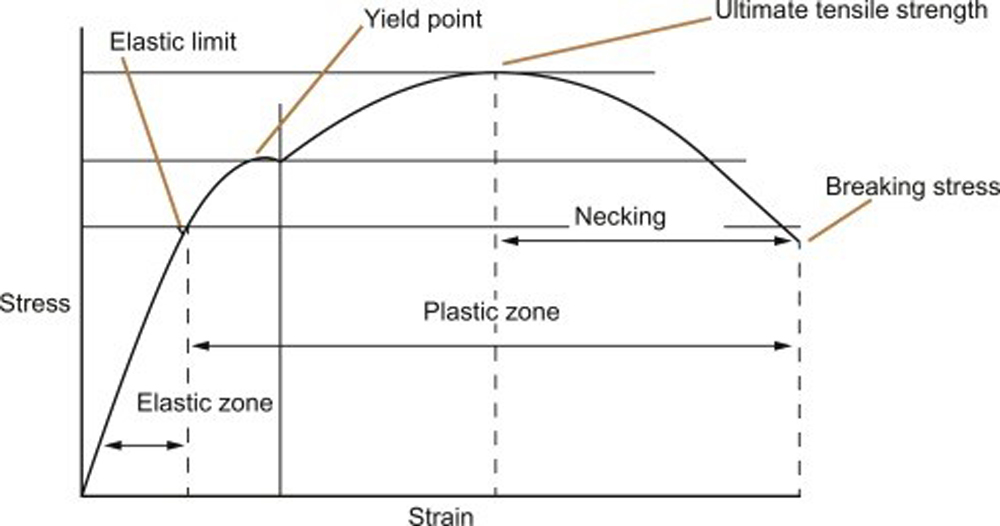
Theoretical stress strain bend and features
The tensile strength and yield strength of a material are often expressed equally a unit of stress (psi, Mpa), which is calculated by dividing the forcefulness applied past the cross-sectional expanse of the section that force is applied to. The ductility of a textile can be quantified equally percentage elongation, which is an expression of strain. Strain is calculated past dividing the change in length caused by an applied forcefulness, by the full length of the stressed section. Per centum elongation is an expression of the strain at fracture as a pct: [(final length – initial length) / initial length] x 100. It represents how much a material can be stretched beyond its original dimension without breaking. Metals do not ever plastically deform in response to stress. The steep region of the curve at lower strains is called the elastic portion because information technology represents not-permanent, or elastic strain. A metallic section can exist stretched a certain amount without plastically deforming, meaning that once the applied forcefulness is removed, that section volition return to its original dimensions. Understanding the size of the elastic portion of a curve is important in metal forming considering a textile's elasticity volition translate into spring back. The more strain a cloth can realize without plastically deforming, the more leap back there will exist.
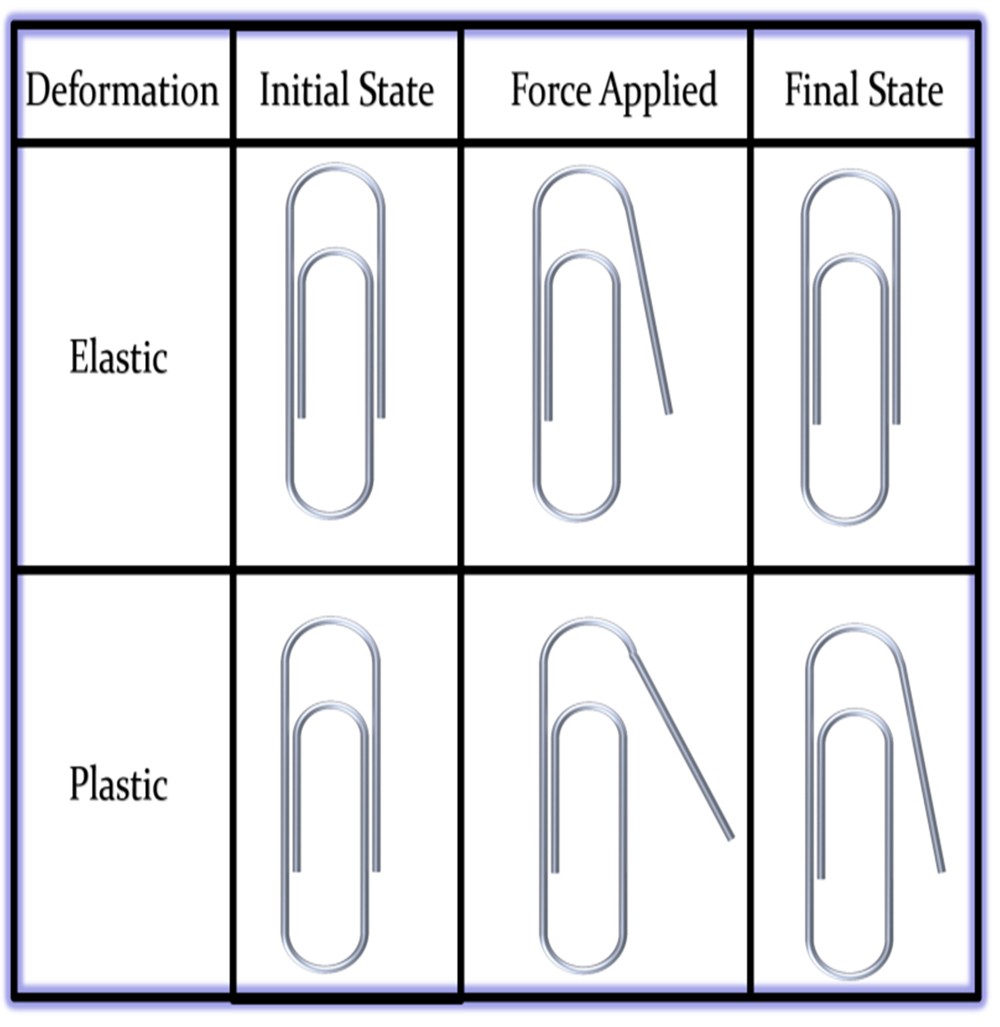
Elastic vs Plastic Deformation. In the plastic row, the difference in position between the paper prune arm in the "strength applied" paradigm and the "final state" image is often called "spring back".
Temper classifications are nomenclature accepted across the metals industry to make it easier for parts manufacturers to society cloth with consistent and anticipated mechanical backdrop. The American Social club for Testing and Materials, or ASTM, writes and publishes specifications to define tempers. Ulbrich's customers often consult ASTM A666: Standard Specification for Annealed or Cold-Worked Austenitic Stainless Steel Sheet, Strip, Plate, and Apartment Bar, when selecting a material and temper for a formed part. ASTM A666 provides mechanical belongings requirements for 200 and 300 series alloys for the post-obit conditions from softest and hardest respectively: Annealed, 1/xvi hard, 1/8 hard, ¼ difficult, ½ hard, ¾ hard, full hard and super full hard. The specification details requirements for almost all the alloys for 1/16 through ½ difficult, but for ¾ hard and full difficult, simply 201, 205, 301, 302 take specified properties. At super full hard, the only alloys included in the table are 301 and an blend that is exclusively specified for super total hard: 301SI. UNS S30116, or 301SI, can achieve any of the lower tempers. The reason it is not specified for them, is that 301 has a more predictable work hardening rate in that range. 301SI was designed specifically for high temper applications like springs, fasteners, washers, zippers, clips and clamps. Normal 301 has a maximum Silicon content of 1%, while 301SI has a minimum Silicon content of 1% and a max of 1.35%. Additions of Carbon, Manganese and Silicon all increase the force of austenitic stainless steel. Increasing Carbon and Manganese across the limits specified for 301 can take detrimental side effects, yet it was plant that a nominal addition of Silicon would heave the work hardening rate only enough to justify giving the new composition its own Unified Number System (UNS) designation. As a textile is work hardened, the tensile to yield strength ratio decreases as a byproduct of decreasing ductility. A lower tensile to yield strength ratio ways the rubberband portion of the stress strain bend is larger and the material can have more stress earlier plastically deforming. 301SI is a good alloy for springs because it can achieve higher strengths without fracturing, resulting in elasticity at a wider range of stresses.
It should be noted that, fifty-fifty though ASTM A666 doesn't specify total hard 304, that blend tin can still be tempered above its ½ hard holding range. The reason ¾ and full hard 304 aren't ASTM standard tempers is because the ductility of 304 drops off speedily beyond the ½ hard forcefulness level. When a client requests a quote from Ulbrich for full hard or spring tempered 304, nosotros oftentimes explain that ASTM does non define such a atmosphere, merely then likewise work with them to understand their need. We tin temper 304 to 185 ksi min tensile strength, the minimum tensile strength of total hard 301, simply it will not have the eight% minimum elongation expected of full hard 301. It may but accept iii% or less elongation, but oft this volition be enough ductility to facilitate the customer'south forming procedure and they have other reasons why they prefer 304 over 301.
So, what is the point of having all of these tempers? Why are people tinkering with chemistries and dividing tempers into one/sixteenths? There is then much nuance and skill that goes into successfully forming a role that the tool and dice experts don't always want to have to become a materials science expert as well. There is so much liability in the aerospace, medical or nuclear power industries that their engineers desire to accept proven standards developed and vetted by manufacture veterans to rely upon. Relying on an industry defined atmosphere allows parts manufacturers to eliminate mechanical backdrop as a variable, because they know what forming behavior to expect from a status if they've used it before. Each atmosphere does have a range of commanded tensile, yield and elongation, and so in that location is some variation within whatsoever given temper - especially in the case of the big gap betwixt full hard and super total hard - merely defining tempers similar 3/32 or 5/64 would be a little ridiculous. If an application requires a greater level of precision with regard to raw material mechanical property ranges, a custom specification can be adult, with the assistance of the Ulbrich Technical Services team if desired. If a customer attempts to form a part using ½ hard textile, and experiences brittle fractures due to a lack of ductility they tin try ¼ hard material. If the ¼ hard material doesn't accomplish the desired hardness after forming, so they might need the equivalent of a 3/eight hard atmosphere, which volition need to be specified beyond an ASTM reference.
How does Ulbrich Specialty Strip Mill achieve a given temper? In the example of an annealed product, the strip undergoes rolling and annealing cycles until the ordered thickness is accomplished. The strip then undergoes a final anneal cycle to reset the microstructure and found the uniform and equiaxed grain construction expected of an annealed product. In the example of tempered items, there is no final anneal operation. Instead, a specific amount of strain is induced via cold rolling in order to work harden the production to the desired mechanical properties. This strain is expressed as a ratio of the starting thickness and final thickness referred to as percent reduction. If a production is rolled from .020" thick to .010", it has undergone a l% reduction in thickness. Ulbrich performs a statistical analysis using its long history of mechanical property information accrued through quality control testing to predict the right pct reduction for a given atmosphere condition. This number can vary based on factors like alloy, individual lot chemical science and fifty-fifty last thickness. The percent reduction in thickness needed to achieve total hard volition ever exist much higher than the reduction needed for ¼ hard, but ii 301 lots beingness rolled to the aforementioned full hard condition may require unlike percent reductions. Ulbrich technology aims to finely control processes in order to reduce variation between lots as much as possible. If a 301 product with properties near the low end of the ¼ hard range works for a customer, a process volition exist developed to achieve backdrop nearly the low stop. Every step of a manufacturing process has variation, and past reducing the variation in raw cloth mechanical properties a stamping business firm may not have to tweak their setup quite as much when starting a new lot of fabric.
Source: https://www.ulbrich.com/blog/the-basics-of-stainless-steel-temper-conditions/
0 Response to "what metal can be hardened to the 1025 condition"
Postar um comentário